

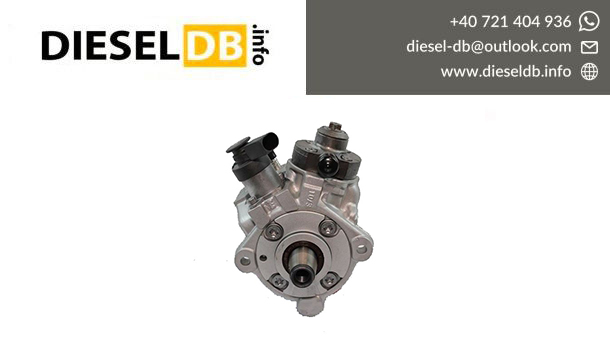
Bosch High-Pressure Pump 0445010576 — Ford 1.5 TDCi Common Rail Diesel Engine
The Bosch High-Pressure Pump 0445010576 is a genuine Bosch CP4 common rail pump engineered for the Ford 1.5 TDCi (DLD-415) diesel engine — the four-cylinder turbocharged unit fitted to a wide range of Ford small cars and light commercial vehicles from 2012 onwards. Carrying Ford OEM reference CV2Q-9A543-AA and interchange number 0445010577, this pump is responsible for generating the high-pressure fuel supply to the common rail and injectors. Whether you are a diesel workshop sourcing a new pump for a failed unit, a parts specialist managing workshop stock, or a vehicle owner researching the correct replacement for your Ford B-MAX, Fiesta, EcoSport, or Courier variant, this article covers the technical specification, OEM cross-references, engine applications, vehicle fitment, failure symptoms, and frequently asked questions for Bosch part number 0445010576.
Bosch Part Number Reference
| Field | Detail |
|---|---|
| Bosch Part Number | 0 445 010 576 |
| Short Number | 0445010576 |
| Designation | High-Pressure Pump — Common Rail System |
| Pump Series | Bosch CP4 (CP4S1) |
| Interchange / Supersession | 0445010577 / 0986437449 |
| Condition | New (Genuine Bosch) |
Note: Part 0986437449 is the Bosch aftermarket/exchange programme number for this pump. Interchange number 0445010577 covers a closely related CP4 variant used across overlapping Ford 1.5 TDCi applications. Always verify against your vehicle’s VIN and engine code before ordering.
OEM Cross-Reference Numbers
| OEM Brand | OEM Number | Notes |
|---|---|---|
| Ford | CV2Q-9A543-AA | Primary Ford OEM part number; stamped on the original pump and listed in Ford spare parts catalogue for 1.5 TDCi applications |
| Ford | CV2Q9A543AA | Alternative format of the same Ford OEM number (without hyphens); used in electronic parts catalogues and online lookup systems |
| Ford | 1784745 | Ford numeric spare parts reference; used in some regional Ford parts systems alongside the alphanumeric OEM number |
OEM numbers confirmed from Ford spare parts documentation and component identification data. Always cross-check against your vehicle’s build plate, engine code, and Ford parts portal (ETIS or ECAT) before ordering.
Injection System Type — Bosch CP4 Common Rail High-Pressure Pump
The Ford 1.5 TDCi uses a Bosch CP4 single-plunger common rail high-pressure pump — part of the widely deployed CP4 (CP4S1) pump family that Bosch has produced in excess of 60 million units globally. In the common rail system, the high-pressure pump’s sole function is to generate and maintain fuel pressure in the shared high-pressure rail, from which the electronically controlled injectors draw fuel at precisely timed intervals and quantities.
Key operating principles of the CP4 system on this engine:
- Single-plunger design — the CP4S1 variant uses one high-pressure pumping element, making it compact and well-suited to small-displacement engines such as the 1.5 TDCi
- Metering unit (suction control valve) — an electrically controlled metering unit on the low-pressure inlet side regulates the amount of fuel admitted to the high-pressure element on each stroke, controlling rail pressure in response to the engine control unit (ECU)
- Camshaft-driven — the pump is driven directly off the engine’s camshaft via a belt or gear drive, running at a fixed ratio relative to engine speed
- Operating pressure — the CP4 system on the Ford 1.5 TDCi operates at rail pressures from approximately 250 bar at idle up to around 1,600–1,800 bar at full load, depending on operating conditions and emission calibration
- Fuel lubrication — the CP4 pump’s internal components are lubricated solely by the diesel fuel passing through the pump; fuel quality and contamination-free operation are therefore critical to pump longevity
The CP4 is noted as a precision component with tight internal tolerances. It is significantly more sensitive to fuel contamination, water ingress, and low-lubricity fuel than its predecessor the CP3. On vehicles operating in markets where fuel quality is variable, or where DPF regeneration additives are used incorrectly, premature CP4 wear is a documented issue. This is why genuine Bosch replacement or remanufactured units — calibrated and tested to OEM specification — are the strongly recommended replacement option.
Engine Application
| Engine Code | Engine Family | Displacement | Configuration | Fuel System |
|---|---|---|---|---|
| T3CA, T3CB, T3CC, T3JA, T3JB, TZJA, TZJB, UGCA, UGCB, UGJC, UGJE, UGJG, XUCC, XUCD, XUCE, XUCF, XUCG, XUJA, XUJB, XVCE, XVCF, XWCA, XWCB, XXCA, XXCB, XXCC | Ford DLD-415 (Duratorq TDCi 1.5) | 1,499 cc (1.5 L) | Inline-4, SOHC 8-valve, turbocharged, intercooled | Bosch CP4 Common Rail Direct Injection |
Engine key data — Ford 1.5 TDCi (DLD-415):
- Displacement: 1,499 cc
- Bore × stroke: 73.5 mm × 88.3 mm
- Configuration: Inline-4, SOHC, 8 valves (2 per cylinder), hydraulic tappets
- Block: Aluminium with cast-iron cylinder liners
- Head: Aluminium
- Timing drive: Belt
- Aspiration: Turbocharged with intercooler
- Fuel system: Bosch Common Rail, CP4 high-pressure pump, electromagnetic injectors
- ECU: Bosch EDC17 (various variants)
- Turbocharger: MHI TD02H2 (lower-power versions) / Honeywell GTD1244VZ variable-geometry (higher-power versions)
- Introduction: 2012 (first generation); updated to EcoBlue standard in 2018
- Power range: 55 kW (75 PS) to 88 kW (120 PS) depending on variant and calibration
Power Output by Engine Code Variant
| Engine Code (examples) | Power Output | Torque | Notes |
|---|---|---|---|
| T3CA, UGCA, XUCC | 55 kW (75 PS / 74 hp) | 185 N·m | Entry-level output; Fiesta, B-MAX, Courier variants |
| T3CB, UGCB, XUCD, XWCA | 70 kW (95 PS / 94 hp) | 215–220 N·m | Mid-range output; most common variant in B-MAX and Fiesta VI |
| UGJC, UGJG, XUCE, XWCB | 77 kW (105 PS / 103 hp) | 240–250 N·m | ECOnetic and higher-trim variants; VGT turbocharger |
| XXCA, XXCB, XXCC | 88 kW (120 PS / 118 hp) | 270 N·m | Top-output version; later Fiesta and EcoSport applications |
Power and torque figures are representative values for each calibration tier. Exact outputs vary by market, model year, and emission compliance level. Always confirm via the engine code stamped on the block or listed on the vehicle identification plate.
Vehicle Application
| Make | Model | Variant / Body Style | Engine | Production Period |
|---|---|---|---|---|
| Ford | B-MAX | 5-door mini MPV | 1.5 TDCi 75 PS / 95 PS | 2012 – 2017 |
| Ford | EcoSport | 5-door crossover SUV | 1.5 TDCi 95 PS / 100 PS | 2013 onwards |
| Ford | Fiesta VII Hatchback | 3/5-door hatchback (Mk6 facelift) | 1.5 TDCi 75 PS / 95 PS / 105 PS | 2012 onwards |
| Ford | Fiesta VI Van | Panel van | 1.5 TDCi 75 PS / 95 PS | 2012 onwards |
| Ford | Tourneo Courier B460 | Compact MPV (Kombi) | 1.5 TDCi 75 PS / 95 PS / 100 PS | 2014 onwards |
| Ford | Transit Courier B460 | Box van / Kombi | 1.5 TDCi 75 PS / 95 PS / 100 PS | 2014 onwards |
This pump is confirmed for Ford vehicles only. Always verify fitment using the engine code and VIN — the 1.5 TDCi range covers a large number of calibration variants (engine codes) and not all use the same pump specification.
Technical Specifications
| Parameter | Specification |
|---|---|
| Bosch Part Number | 0 445 010 576 |
| Pump Series | Bosch CP4 (CP4S1 — single-plunger) |
| Pump Type | High-pressure common rail pump with metering unit |
| Operating Pressure | Up to approx. 1,600–1,800 bar rail pressure |
| Drive | Camshaft-driven (belt drive) |
| Pressure Regulation | Inlet metering unit (suction control valve) — ECU-controlled |
| Lubrication | Fuel-lubricated internal components |
| Ford OEM Number | CV2Q-9A543-AA / 1784745 |
| Interchange Numbers | 0445010577 / 0986437449 |
| Engine Application | Ford 1.5 TDCi (DLD-415), 1,499 cc, multiple engine codes |
| Condition | New — genuine Bosch |
Common Failure Symptoms
A failing Bosch CP4 pump on the Ford 1.5 TDCi will typically produce one or more of the following symptoms. Because the CP4’s internal components are fuel-lubricated and operate at very high pressures, wear or damage tends to escalate rapidly — early diagnosis and prompt replacement prevents injector contamination and rail damage.
- Hard starting or extended cranking before start — a worn pump that cannot build sufficient rail pressure requires prolonged cranking before the minimum injection pressure threshold is reached; cold starts are often worst affected
- Loss of power under load — insufficient high-pressure fuel delivery causes the engine to feel flat or hesitant under acceleration, particularly at higher engine loads where rail pressure demand is greatest
- Rough idle or unstable engine running — irregular rail pressure causes inconsistent injection quantity and timing, producing a lumpy, unstable idle or rough combustion noise
- Fault codes relating to rail pressure — common DTCs include P0087 (fuel rail pressure too low), P0191 (fuel rail pressure sensor range/performance), and P1093 (fuel rail pressure too low during power enrichment); these are frequently logged before drivability symptoms become obvious
- Excessive black or grey smoke — poor rail pressure results in incomplete atomisation and combustion, producing visible exhaust smoke especially under acceleration
- Stalling under load or at low speed — in severe cases, the pump cannot maintain minimum rail pressure during low-speed high-load conditions (slow manoeuvring, hill starts), causing the engine to stall
- Metal contamination in the fuel system — CP4 pump wear generates fine metal particles that circulate through the high-pressure fuel circuit; if a pump has failed catastrophically, the injectors, rail, and high-pressure lines must be inspected and flushed before fitting a new pump, or premature failure of the replacement will occur
- Fuel return circuit abnormalities — the metering unit (suction control valve) can fail independently, causing incorrect rail pressure regulation even when the mechanical pump element is undamaged; this may produce similar symptoms to a worn pump but can sometimes be resolved by replacing the metering unit alone
Frequently Asked Questions
1. What vehicles does Bosch 0445010576 fit?
This pump is confirmed for the Ford 1.5 TDCi (DLD-415) engine across the following models: Ford B-MAX (2012–2017), Ford EcoSport (2013 onwards), Ford Fiesta VII Hatchback (2012 onwards), Ford Fiesta VI Van, Ford Tourneo Courier B460, and Ford Transit Courier B460. The engine codes covered span a large number of variants including T3CA, T3CB, UGCA, UGCB, UGJC, XUCC, XUCD, XWCA, XWCB, and others — always verify the engine code on your specific vehicle before ordering.
2. What is the Ford OEM part number for this pump?
The primary Ford OEM reference is CV2Q-9A543-AA (also written as CV2Q9A543AA without hyphens). A Ford numeric reference of 1784745 is also associated with this application. If you are sourcing from a Ford dealer or using a Ford ECAT / ETIS lookup, either of these numbers will identify the correct pump for 1.5 TDCi applications.
3. What is the difference between 0445010576 and 0445010577?
These two Bosch part numbers are closely related CP4S1 pump variants used across overlapping Ford 1.5 TDCi applications. They appear as interchange/supersession numbers for each other in parts catalogues. In practice, the differences are likely minor calibration or manufacturing revisions rather than fundamentally different pumps. However, fitment should always be confirmed against your specific engine code — do not assume cross-compatibility without verifying your application in the Bosch catalogue or with your parts supplier.
4. Why is the CP4 pump considered sensitive to fuel quality?
The Bosch CP4’s internal high-pressure components — the plunger, barrel, and cam follower — are lubricated entirely by the diesel fuel passing through the pump. Unlike its predecessor the CP3, the CP4 operates at higher pressures with tighter manufacturing tolerances and smaller internal clearances. This makes it more susceptible to damage from water-contaminated fuel, biodiesel blends above the specified limit, fuels with insufficient lubricity (including some ULSFO formulations), and particulate contamination. Fuel quality issues that a CP3 would tolerate can cause measurable wear in a CP4 within a short time. Maintaining clean, uncontaminated fuel and replacing the fuel filter at the manufacturer’s specified interval is therefore particularly important on vehicles with this pump.
5. If the CP4 pump has failed, do I need to replace the injectors as well?
It depends on the failure mode. If the pump has failed gradually through wear (loss of pressure, reduced flow), and there are no metal particle symptoms in the fuel system, replacing the pump and flushing the system is often sufficient. However, if the pump has failed catastrophically — particularly if the plunger has fractured or the cam follower has disintegrated — metal debris will have been circulated throughout the high-pressure fuel circuit. In this scenario, the injectors, fuel rail, and high-pressure pipes must be inspected, and in many cases the injectors must be replaced or professionally cleaned and tested. Fitting a new pump into a contaminated fuel system without proper flushing will destroy the replacement pump, often within hours.
6. Can I fit a remanufactured CP4 pump instead of a new one?
A professionally remanufactured CP4 pump — such as those rebuilt by Bosch or authorised remanufacturing stations with a certified calibration report — is a legitimate and cost-effective option, particularly for older vehicles where the cost of a new pump may be disproportionate. The key requirements are: the pump must be remanufactured to OEM specification with replacement of all wear components; it must be calibrated on a dynamic test bench and supplied with a calibration protocol; and the fuel system must be clean before installation. Exchange or reman units supplied without a calibration report should be avoided.
7. What fault codes are typically associated with a failing CP4 pump on the Ford 1.5 TDCi?
The most commonly logged codes related to CP4 pump failure are P0087 (fuel rail pressure below specified value), P0191 (fuel rail pressure sensor performance), and P1093 (low fuel rail pressure during enrichment). In some cases P0090 (fuel pressure regulator control circuit) or codes related to the metering unit solenoid may also appear. These codes can have other causes — including a blocked fuel filter, a faulty fuel pressure sensor, or a failed pressure relief valve — so a complete fuel system diagnostic, including dynamic rail pressure measurement under load, should be carried out before condemning the pump.
8. How is the CP4 pump driven on the Ford 1.5 TDCi, and is there a replacement interval?
The CP4 pump on the Ford 1.5 TDCi is driven by the engine’s camshaft via the cam belt (timing belt) drive. There is no independent replacement interval for the pump itself — it is designed as a lifetime component under normal operating conditions. However, the pump drive is shared with the cam belt system, so any cam belt service must account for the pump drive connection. Pump failure is almost always caused by fuel quality issues, contamination, or (less commonly) internal fatigue rather than a scheduled wear-out. Replacing the fuel filter at the manufacturer’s specified service interval is the single most effective preventive measure.
Conclusion
Bosch High-Pressure Pump 0445010576 is the correct OEM-grade CP4 common rail pump for the Ford 1.5 TDCi (DLD-415) engine fitted to the B-MAX, EcoSport, Fiesta, Fiesta Van, Tourneo Courier, and Transit Courier. With Ford OEM references CV2Q-9A543-AA and 1784745, and interchange number 0445010577, this pump is a well-catalogued and widely available genuine Bosch component. Given the CP4’s sensitivity to fuel contamination and the risk of injector damage from a failed pump, sourcing a genuine or certified-remanufactured unit — and ensuring the fuel system is clean before installation — is the correct approach for any 1.5 TDCi high-pressure pump replacement.
To order Bosch 0445010576 or to enquire about availability, visit our product page or contact our technical sales team directly. We stock genuine Bosch common rail components and can advise on complete fuel system overhaul parts for the Ford 1.5 TDCi platform.
Tags: Ford
